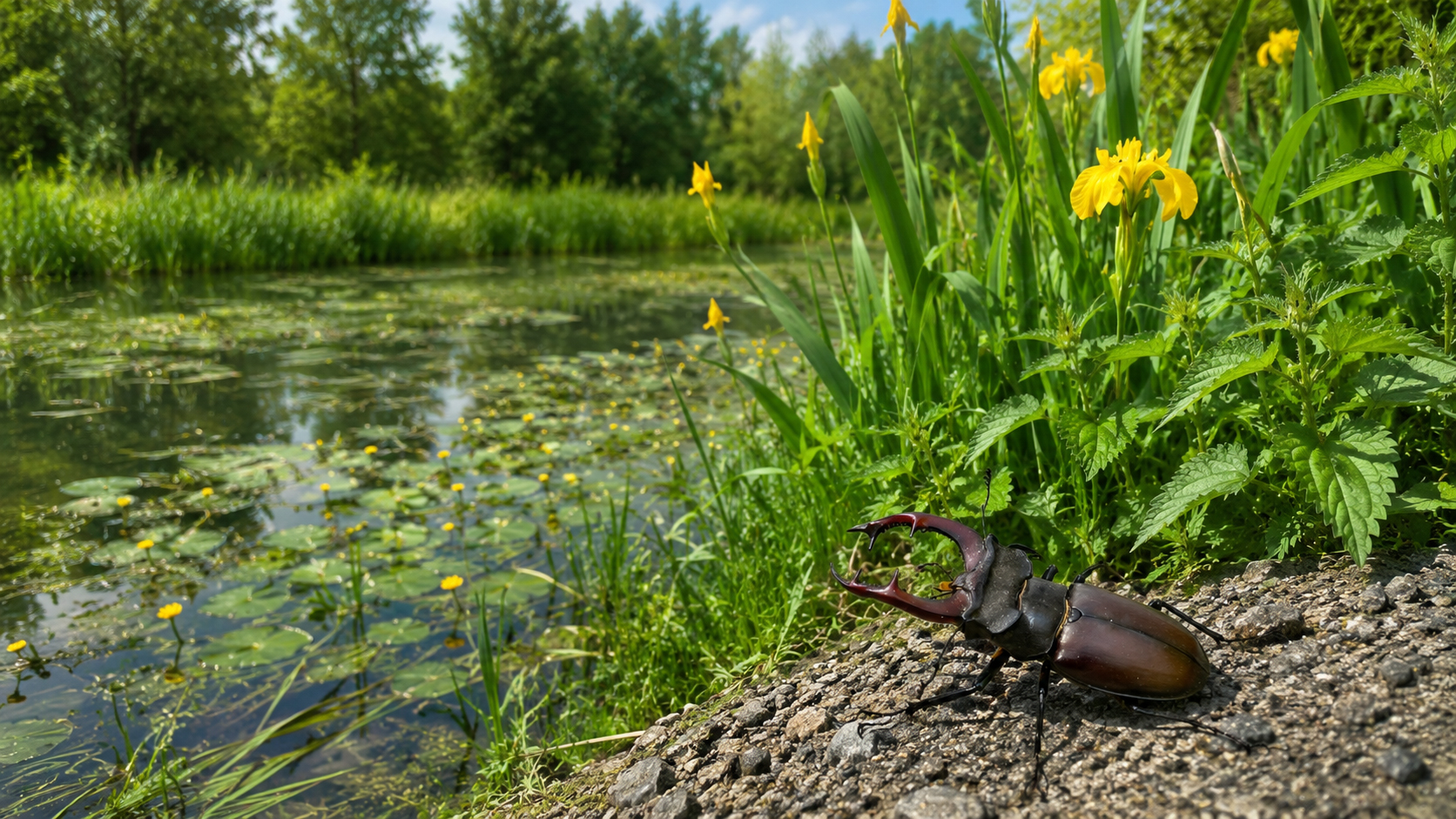
Deutung der Begrifflichkeit „Natur“ Interpretation of the term “nature”
Natur als materielle Wirklichkeit Nature as material reality
Natur umfasst sowohl belebte Elemente wie Pflanzen, Tiere und Mikroorganismen als auch unbelebte Bestandteile wie Gestein, Wasser, Luft, Böden und atmosphärische Systeme. Sie ist damit nicht bloß eine Kulisse menschlichen Handelns, sondern die Grundlage jeder Form von Ernährung, Gesundheit, Sicherheit, Wirtschaft und Kultur. Nature includes both living elements, such as plants, animals and microorganisms, and non-living components, such as rocks, water, air, soils and atmospheric systems. It is therefore not merely a backdrop for human action, but the foundation of every form of food supply, health, security, economy and culture.
Gerade deshalb ist der Schutz der Natur keine romantische Nebensache. Er betrifft die Stabilität ganzer Gesellschaften. Wenn Wasser, Böden, Wälder, Artenvielfalt und klimatische Systeme beschädigt werden, geraten nicht nur ökologische Gleichgewichte unter Druck, sondern auch soziale Ordnung, wirtschaftliche Leistungsfähigkeit und politische Handlungsfähigkeit. For this reason, protecting nature is not a romantic secondary concern. It concerns the stability of entire societies. When water, soils, forests, biodiversity and climatic systems are damaged, not only ecological balances come under pressure, but also social order, economic capacity and political agency.
Klimakrise, 1,5-Grad-Ziel und globale Verantwortung Climate crisis, the 1.5-degree target and global responsibility
Der schwedische Klimaforscher Johan Rockström, Direktor des Potsdam-Instituts für Klimafolgenforschung, warnte bereits im Zusammenhang mit der Weltklimakonferenz COP26 im Jahr 2021 in Glasgow eindringlich davor, dass die bis dahin vorgelegten nationalen Klimapläne nicht ausreichen würden, um das 1,5-Grad-Ziel des Pariser Klimaabkommens einzuhalten. Nach damaligen Einschätzungen der UN-Klimarahmenkonvention bewegte sich die Welt vielmehr auf einen deutlich zu hohen Erwärmungspfad zu. Ein solcher Temperaturanstieg würde die Menschheit in ein ökologisch, sozial und sicherheitspolitisch kaum kalkulierbares Risikofeld führen. The Swedish climate scientist Johan Rockström, Director of the Potsdam Institute for Climate Impact Research, warned in connection with the COP26 World Climate Conference in Glasgow in 2021 that the national climate plans submitted at that time would not be sufficient to keep the 1.5-degree target of the Paris Agreement within reach. According to assessments by the United Nations Framework Convention on Climate Change at that time, the world was instead moving towards a warming pathway that was far too high. Such a rise in temperature would lead humanity into an ecological, social and security-related risk zone that would be extremely difficult to control.
Die UN-Klimarahmenkonvention wies 2021 darauf hin, dass die damals vorliegenden nationalen Klimaschutzbeiträge weiterhin deutlich zu schwach waren, um die globale Erwärmung auf ein noch beherrschbares Maß zu begrenzen. Das Pariser Klimaabkommen setzt demgegenüber die Zielmarke, die Erderwärmung deutlich unter 2 Grad Celsius und möglichst auf 1,5 Grad Celsius zu begrenzen. Nach Angaben der UNFCCC müssen die globalen Treibhausgasemissionen dafür spätestens vor 2025 ihren Höhepunkt erreichen und bis 2030 erheblich sinken. In 2021, the United Nations Framework Convention on Climate Change stated that the national climate commitments then available remained far too weak to limit global warming to a manageable level. By contrast, the Paris Agreement sets the objective of holding global warming well below 2 degrees Celsius and pursuing efforts to limit it to 1.5 degrees Celsius. According to the UNFCCC, global greenhouse gas emissions must peak before 2025 at the latest and decline substantially by 2030 in order to keep this pathway within reach.
Rockström machte in diesem Zusammenhang deutlich, dass ein deutlich höheres Erwärmungsniveau nicht bloß eine abstrakte klimatische Veränderung bedeuten würde, sondern eine tiefgreifende Verschiebung der Lebensbedingungen auf der Erde. Häufigere und intensivere Extremereignisse wie Dürren, Überschwemmungen, Waldbrände, Hitzewellen, Ernteausfälle und klimabedingte Gesundheitsrisiken würden viele Regionen der Erde erheblich belasten. Die Klimakrise ist deshalb nicht nur eine ökologische Frage, sondern auch eine Frage von Frieden, Sicherheit, Gesundheit, Migration, Ernährung und politischer Stabilität. In this context, Rockström made it clear that a significantly higher level of warming would not simply represent an abstract climatic shift, but a profound transformation of living conditions on Earth. More frequent and more intense extreme events, such as droughts, floods, wildfires, heatwaves, crop failures and climate-related health risks, would place severe pressure on many regions of the world. The climate crisis is therefore not only an ecological issue, but also a question of peace, security, health, migration, food supply and political stability.
Natur als Gegenstand menschlicher Erkenntnis Nature as an object of human knowledge
Natur lässt sich jedoch nicht allein als Summe äußerer, vom Menschen unabhängiger Dinge verstehen. In erkenntnistheoretischer Hinsicht ist Natur auch das, was dem Menschen durch Sinnlichkeit, Wahrnehmung und begriffliche Ordnung zugänglich wird. Der Mensch begegnet Natur nicht voraussetzungslos, sondern immer durch die Formen seiner Erfahrung, durch wissenschaftliche Modelle, kulturelle Deutungen und gesellschaftliche Praktiken. However, nature cannot be understood merely as the sum of external things existing independently of human beings. From an epistemological perspective, nature is also what becomes accessible to human beings through sensory perception, cognition and conceptual ordering. Human beings do not encounter nature without preconditions; they always perceive and interpret it through forms of experience, scientific models, cultural meanings and social practices.
Natur ist daher zugleich materielle Wirklichkeit und Gegenstand menschlicher Erkenntnis. Genau darin liegt ihre besondere Bedeutung: Sie ist nicht nur Ressource, sondern Lebensgrundlage, Erfahrungsraum und Grenze menschlicher Verfügungsmacht. Wer Natur ausschließlich als Material behandelt, übersieht, dass menschliche Freiheit selbst auf stabile natürliche Bedingungen angewiesen bleibt. Nature is therefore both material reality and an object of human knowledge. This is precisely where its special significance lies: nature is not merely a resource, but the foundation of life, a space of experience and a limit to human control. Anyone who treats nature exclusively as material overlooks the fact that human freedom itself remains dependent on stable natural conditions.
COP30: Fortschritt, Blockade und die Sicherheitsfrage COP30: progress, blockade and the security question
Die Weltklimakonferenz COP30 im Jahr 2025 in Belém, Brasilien, machte erneut deutlich, dass die internationale Klimapolitik zwischen Fortschritt und Blockade steht. Einerseits wurden Fortschritte bei Anpassung, Klimafinanzierung, Regenwaldschutz und der Umsetzung des Pariser Abkommens hervorgehoben. Andererseits blieb der Umgang mit fossilen Energien politisch umstritten. Die COP30-Präsidentschaft kündigte deshalb nach Abschluss der Konferenz weitere Roadmaps an, unter anderem zum Übergang weg von fossilen Energien sowie zum Stopp und zur Umkehr von Entwaldung und Waldschädigung bis 2030. The COP30 World Climate Conference in Belém, Brazil, in 2025 once again demonstrated that international climate policy stands between progress and blockade. On the one hand, progress was highlighted on adaptation, climate finance, rainforest protection and the implementation of the Paris Agreement. On the other hand, the handling of fossil fuels remained politically contested. After the conference, the COP30 Presidency therefore announced further roadmaps, including one on transitioning away from fossil fuels and another on halting and reversing deforestation and forest degradation by 2030.
Zusätzlich erschwerte der erneute Rückzug der Vereinigten Staaten aus dem Pariser Klimaabkommen die internationale Klimadiplomatie. Die US-Regierung leitete diesen Rückzug am 20. Januar 2025 erneut ein. Damit zeigt sich erneut: Klimaschutz ist kein technisches Randthema, sondern eine zentrale politische, wirtschaftliche und sicherheitspolitische Aufgabe des 21. Jahrhunderts. In addition, the renewed withdrawal of the United States from the Paris Agreement made international climate diplomacy more difficult. The U.S. government initiated this withdrawal again on 20 January 2025. This once again shows that climate protection is not a marginal technical issue, but a central political, economic and security-related task of the 21st century.
Wer Natur schützen will, muss deshalb mehr tun als Emissionen reduzieren. Er muss globale Verantwortung, wissenschaftliche Vernunft, regionale Resilienz, soziale Fairness und politische Handlungsfähigkeit miteinander verbinden. Natur, Frieden und Demokratie gehören in diesem Sinne zusammen: Wird eine dieser Grundlagen dauerhaft beschädigt, geraten auch die anderen unter Druck. Protecting nature therefore requires more than reducing emissions. It requires linking global responsibility, scientific reason, regional resilience, social fairness and political capacity for action. Nature, peace and democracy belong together in this sense: if one of these foundations is permanently damaged, the others also come under pressure.
Quellen und weiterführende Hinweise Sources and further references
-
United Nations Framework Convention on Climate Change (UNFCCC): „Updated NDC Synthesis Report: Worrying Trends Confirmed“, 25.10.2021.
United Nations Framework Convention on Climate Change (UNFCCC): “Updated NDC Synthesis Report: Worrying Trends Confirmed”, 25 October 2021.
https://unfccc.int/news/updated-ndc-synthesis-report-worrying-trends-confirmed -
United Nations Framework Convention on Climate Change (UNFCCC): „The Paris Agreement“.
United Nations Framework Convention on Climate Change (UNFCCC): “The Paris Agreement”.
https://unfccc.int/process-and-meetings/the-paris-agreement -
Potsdam-Institut für Klimafolgenforschung (PIK): Johan Rockström, wissenschaftliche Einordnung zu Klimarisiken und 1,5-Grad-Pfad.
Potsdam Institute for Climate Impact Research (PIK): Johan Rockström, scientific assessment of climate risks and the 1.5-degree pathway.
https://www.pik-potsdam.de/en/news/latest-news/johan-rockstrom-addresses-heads-of-state-during-united-nations-general-assembly-201cfailure-is-not-inevitable-it-is-a-choice201d -
UNFCCC: „UN Climate Change Conference – Belém, November 2025“, offizielle COP30-Informationen.
UNFCCC: “UN Climate Change Conference – Belém, November 2025”, official COP30 information.
https://unfccc.int/cop30 -
COP30 Presidency / UNFCCC: COP30 Presidency Roadmaps zu fossilen Energien und Waldschutz.
COP30 Presidency / UNFCCC: COP30 Presidency Roadmaps on fossil fuels and forest protection.
https://unfccc.int/cop30/cop30-presidency-roadmaps -
The White House: „Putting America First In International Environmental Agreements“, Executive Order vom 20.01.2025.
The White House: “Putting America First In International Environmental Agreements”, Executive Order of 20 January 2025.
https://www.whitehouse.gov/presidential-actions/2025/01/putting-america-first-in-international-environmental-agreements/
Hinweis: Die Quellen werden als Drittquellen sichtbar ausgewiesen. Der erläuternde Text verbindet diese Quellen mit dem Forschungsnarrativ des Campus Baden Institute. Note: The sources are visibly identified as third-party sources. The explanatory text connects these sources with the research narrative of the Campus Baden Institute.